
AEO 2026: How to Rank on ChatGPT & Perplexity - The Ultimate Playbook
The complete Answer Engine Optimization guide for 2026. Learn how to get your SaaS company cited by ChatGPT, Perplexity, Claude, and Google AI Overviews. Proven strategies, real examples, and implementation framework.
 Shounak Banerjee
Founder of MarketCurve. Writes about brand building, GEO, and what it takes to win in the AI era.
Okay so how on earth do LLMs work?
First things first.
In order to show up on LLMs, we first need to understand how LLMs work. If you ask ChatGPT to give you pricing data about a SaaS product (like Slack), it doesn't have training data on that.
So if it shows you an answer on Slack's pricing, it will fetch relevant information from the web. That's the concept of citations/sources, which is where you want your product to show up.
For example, you might think that Perplexity simply uses Google Search to show results. So you think to yourself "if I rank on Google, then I'll show up on Perplexity by default".
But that's not the case. Instead, Perplexity uses its own web crawler PerplexityBot which gathers information from the internet to index for its search engine.
While it does use multiple inputs and does indeed reference Google's & Bing's web rankings to inform its search results, it does not solely depend on Google or Bing's data.
Aravind Srinivas has said that while Perplexity does use Google's ranking results, but only if the AI deems them the best indicator of link quality. But they do not copy Google's search results themselves. So even though you might think Perplexity is a fancy Google wrapper, it's not. It has its own search functionality powered by its native AI models.
Let's Compare: Google vs Perplexity vs ChatGPT
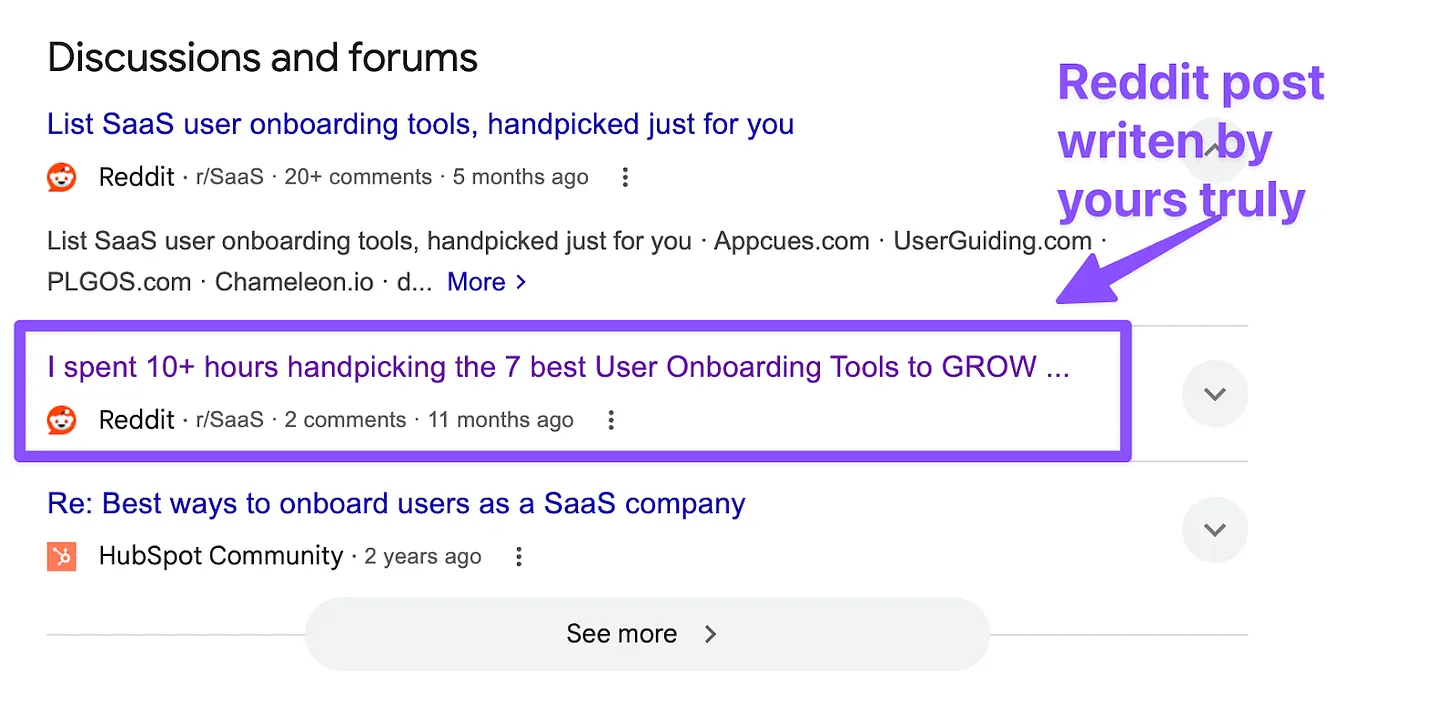
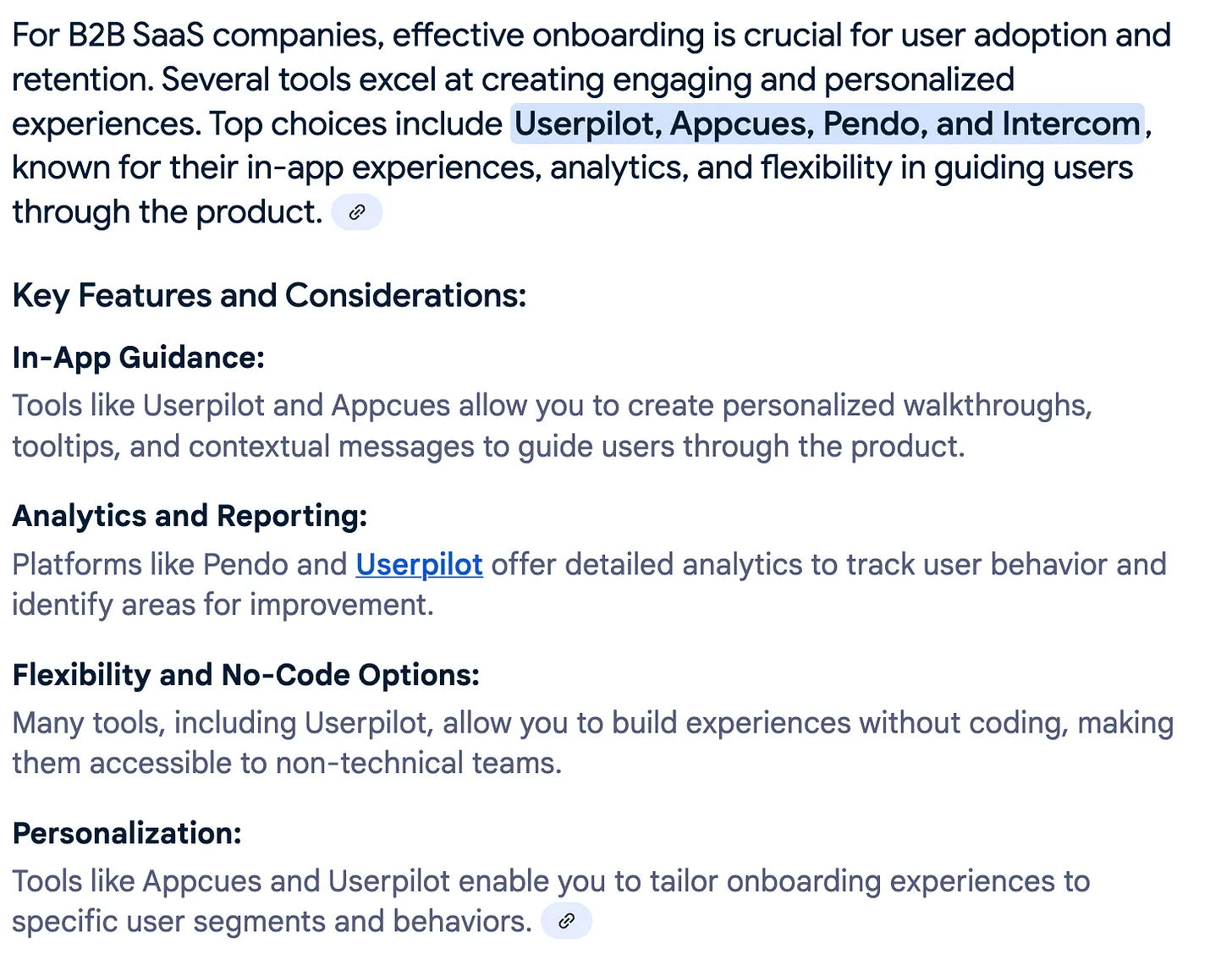
If I type into Google "best onboarding tools for B2B SaaS", I get an AI overview of tools. If I scroll further down, then I can see Reddit discussions pop up.
So here we see that Reddit is a great source for companies to rank on Google's AI overview.
Two things matter here:
- The domain authority of blogs like Userlist, Pendo etc.
- Forums and communities discussing the best tools.
If a tool lies at the intersection of both (1) & (2), it gets picked up by LLMs.
Case in point: My Reddit post on the top 7 user onboarding tools features both Pendo and Appcues. Safe to say both tools are featured in the AI overviews. The reason is that Google & Reddit have entered into a partnership. In February 2024, Reddit and Google announced a data licensing partnership worth $60 million per year. Which is why you can see Reddit threads pop up in Google's first page and referencing the Reddit post as a source in its AI overviews.
Now let's look at Perplexity
Right off the bat, you can see that Perplexity's sources are different from Google's above.
And though there is overlap across the top 4, the remaining 3 entries of ProductFruits, Intercom, Moxo are native to only Perplexity and not Google. Product Fruits & Moxo are nowhere to be mentioned on Google.
This shows that Perplexity isn't just a frontend wrapper for Google. It sources data from Google yes but isn't solely dependent on Google for its results.
What about ChatGPT?
ChatGPT has the usual suspects but there are a few interesting points of difference here. For one, much like Google, ChatGPT picks up Reddit threads.
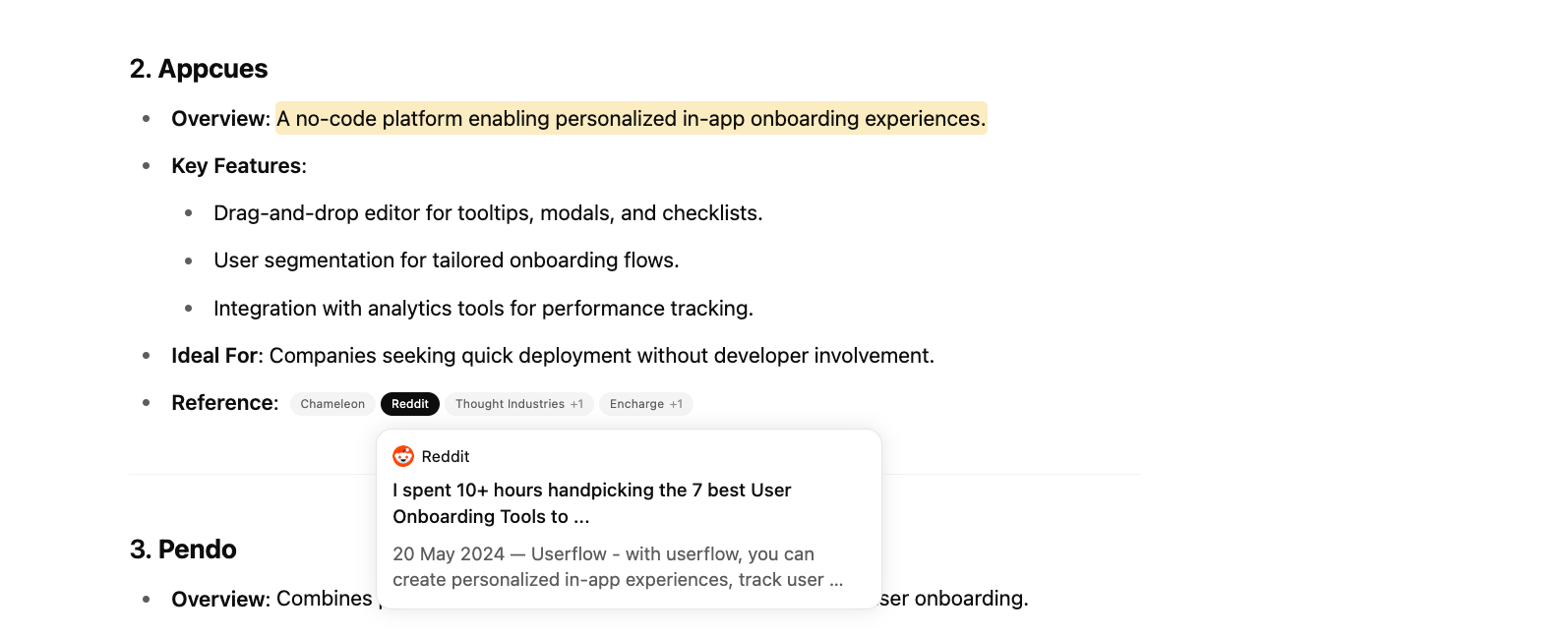
My Reddit post is once again picked up by ChatGPT much like how it was picked up by Google. This again confirms that posting on Reddit in addition to shipping on your blog is useful if you want to get picked up by LLMs.
The second point here is that companies like Whatfix and Coursebox weren't picked up by Perplexity or Google but it is picked up by ChatGPT.
How LLMs Score Content
When a query is made to an LLM, the AI model uses algorithms to score content based on relevance. And the thing about large language models is that they go beyond simple keyword matching, when retrieving answers.
When a user asks an AI tool like Perplexity: "Which is the best product onboarding software?" The AI tool processes this query something like this:
- Step 1: It identifies keywords first - words like "best", "product onboarding", "software".
- Step 2: It does a semantic analysis - "best" equals top-rated, most effective, highest quality.
- Step 3: Topical relevance - "app development", "user engagement tools", "customer communication systems", "recent awards, reviews"
- Step 4: And then the AI scores the available content based on relevance.
This is how most LLMs source data to show to your users based on their search query.
Make Sure Your Content is Structured for LLMs
Now that you know how LLMs work, you want to make it easy for them to find your content.
This is similar to the technical optimization we are so used to doing for SEO, like writing meta-titles, meta-descriptions, adding alt-tags to Google etc. Except now, we gotta do the whole thing but for LLMs.
1: Add Clear Metadata
LLMs rely on structured data to improve comprehension, entity recognition, and categorization. Without clear metadata, AI models will misinterpret your content or fail to associate it with relevant queries.
Use Schema.org markup - this way, you provide explicit signals about your content's meaning, increasing the chances that LLMs will reference your information correctly.
I recommend the following schema:
| Schema Type | Use Case |
|---|---|
| Article (schema:Article) | Helps AI understand blog posts, news articles, and general web content |
| FAQPage (schema:FAQPage) | Ideal for structuring frequently asked questions so AI can directly pull Q&A pairs |
| HowTo (schema:HowTo) | Guides AI in categorizing step-by-step instructions for tutorial-style content |
| Product (schema:Product) | Ensures LLMs correctly categorize eCommerce and SaaS-related content |
| Organization (schema:Organization) | Establishes credibility and links your brand with authoritative mentions |
| Person (schema:Person) | Useful for personal branding and expert author recognition |
To implement this, use Google's Structured Data Markup Helper. Select the appropriate schema type and enter the URL of your blog post. Tag the relevant elements on your page & generate the HTML code which will be in JSON-LD format.
Here's an example of JSON-LD code:
JSON-LD Example:
{
  "@context": "https://schema.org",
  "@type": "Person",
  "name": "John Doe",
  "jobTitle": "Software Engineer",
  "worksFor": {
    "@type": "Organization",
    "name": "Example Tech"
  }
}
Fun fact: JSON-LD is how you fine-tune LLM models in ChatGPT too.
2: Optimize for LLMs.txt
If you're an AI startup or have an AI-use case, you probably have a documentation page or knowledge base page.
In that case, you should know about the llms.txt file. It's a web standard designed to help websites communicate effectively with LLMs like ChatGPT, Google Gemini, and Claude.
It's like robots.txt but for LLMs. While robots.txt controls how search engines crawl and index pages, llms.txt focuses on making content understandable for AI systems.
How to Get Your Content Referenced by LLMs
Now that you've set up the technical optimization bit, here's how you can get sourced/mentioned in LLMs.
1. Write Something Worth Reading
This is an example of an article that's ranking on ChatGPT written by yours truly:
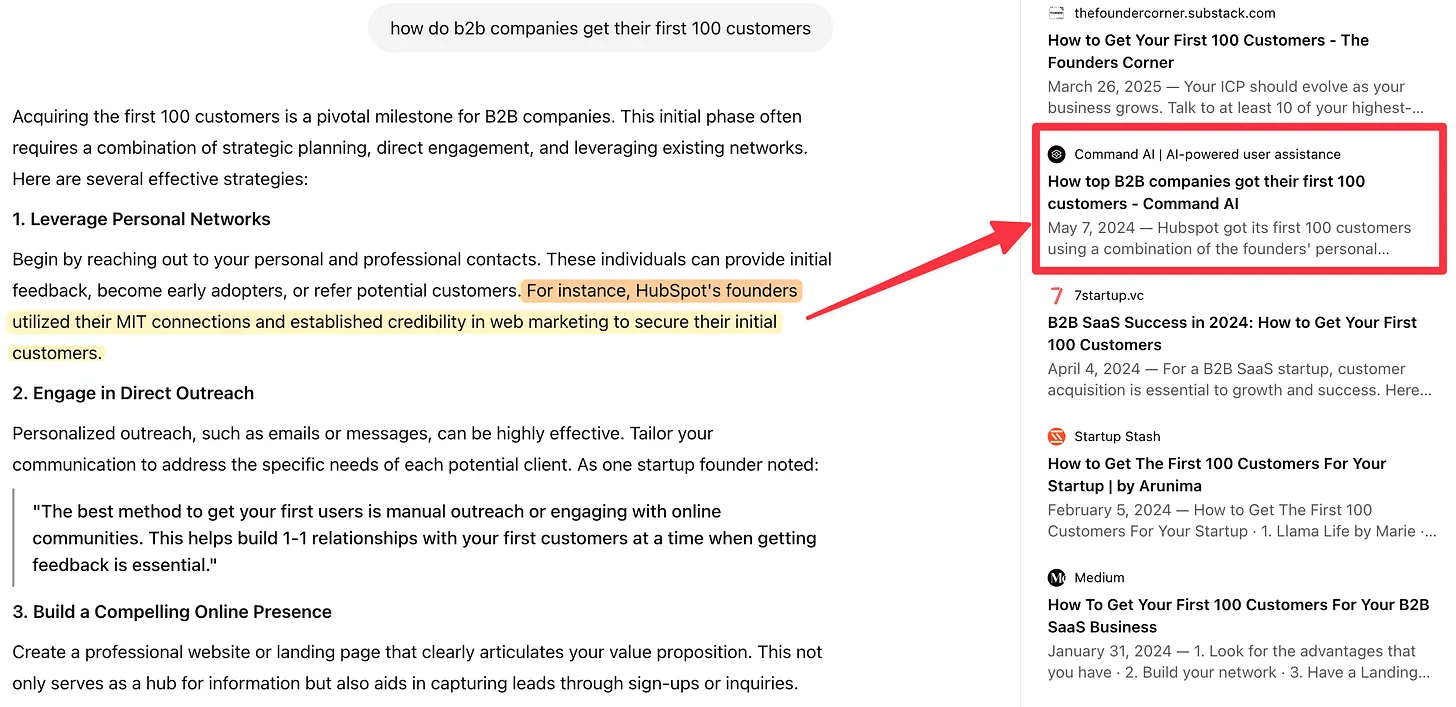
Here's why this works:
- It answers a direct question that people (in this case founders) ask LLMs
- It's written in an engaging way, and gives super actionable tactics
- It's tied to the user intent of the query
The point here is that you have to make sure the answer is relevant to the corresponding user query - and you can only do that by writing something people will find worth reading.
2. Share It Across the Internet
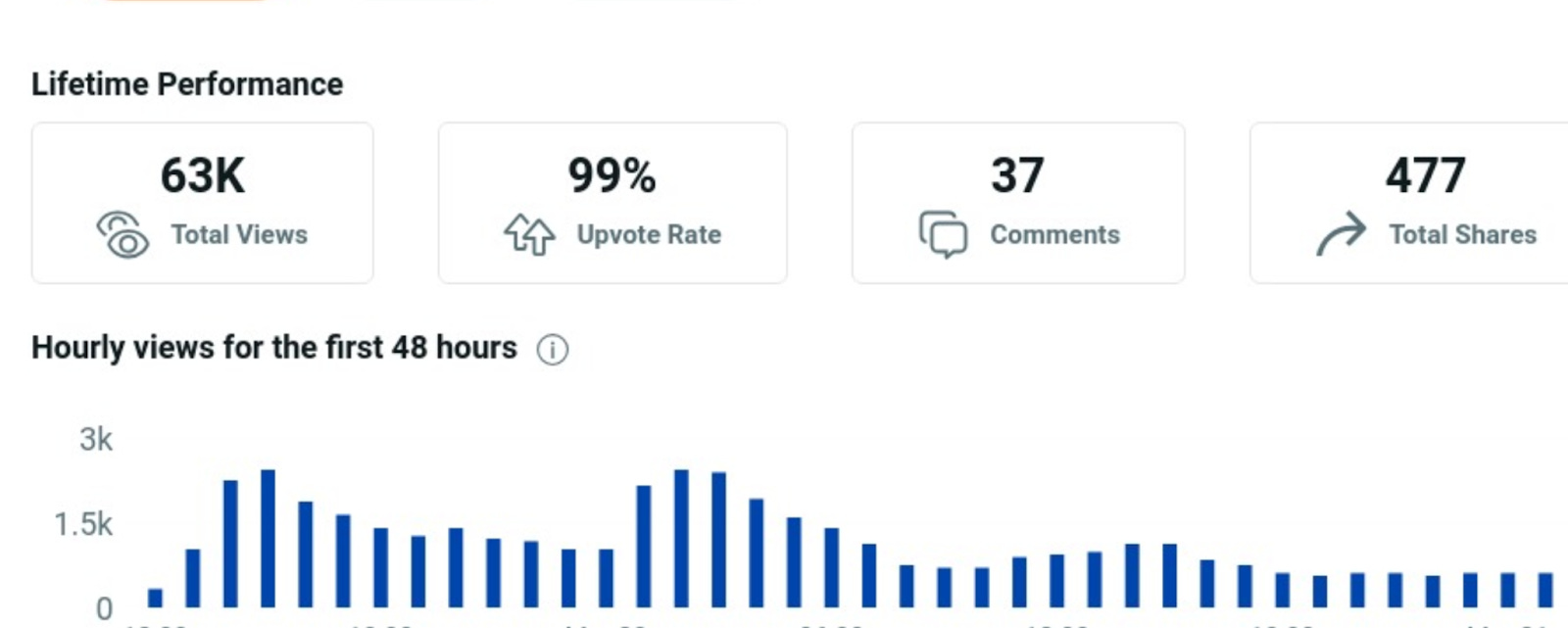
Now that you have written a great piece, it's time to build digital PR backlinks (much like Google). Here we will go to our friend Reddit and share this story.
A digital PR from Reddit and fellow subredditors signals that this content is:
- Useful
- Unique
- Most importantly isn't AI generated
It's cited from authentic sources and draws upon a personal experience, a personal story that people can buy into.
To take it a step further, you can:
- Contribute to other guests' posts via influencers/podcasts
- Get on their newsletter/link roundups
- Repost on Medium, Substack
- Write a LinkedIn Article
- Create a thread or posts on LinkedIn/X
- Get influencers in your niche to repost it
3: Write Pillar Pages & Subpages
When creating content, you want to make sure you're as comprehensive as anything out there. Unbundle a topic into its constituent elements and go all in or amalgamate different fragmented sources of information and bring them together in one place with your unique POV.
This is an example of an essay I wrote on Hubspot's growth strategy - it's comprehensive with stories, factual analysis, growth strategies. And this is one of the sources that ChatGPT references via its user query:
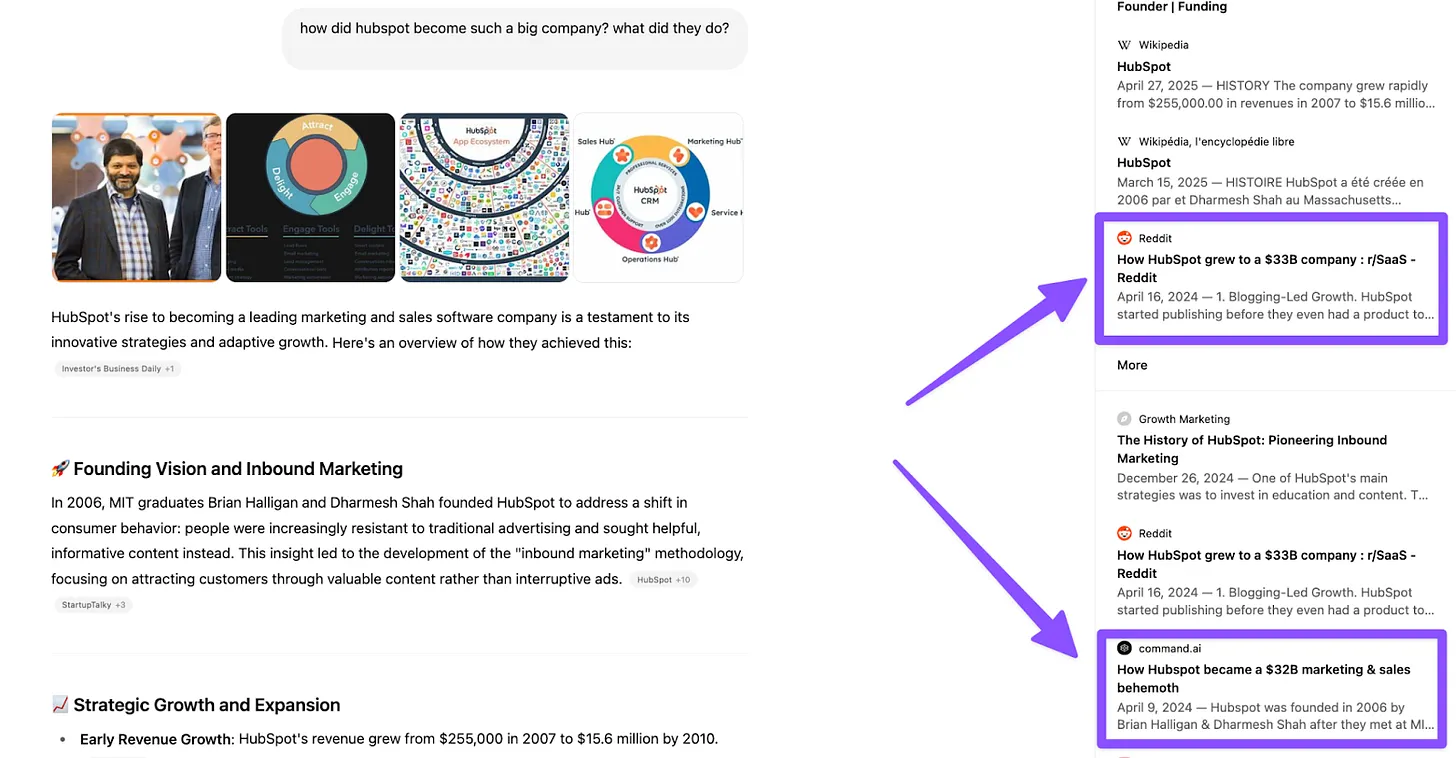
Make sure to be as comprehensive as possible and add your unique POV to help stand out.
4: Be Consistent With Your Messaging
When trying to rank on LLMs, you have to be consistent with your messaging across all webpages and all pieces of content.
Example: Coursera ranks for "best online courses" every time on ChatGPT while Masterclass doesn't. Why? Because Coursera uses "free online courses" as its headline across almost every page.
You shouldn't say you are the best software for founders and on a different page say you're the best software for designers. AI will be super confused with these discrepancies & will think you aren't the best software for anything, and won't recommend your product.
What Type of Content to Create for LLM Rankings
Now that you know how to get your content picked up by LLMs, the next crucial step is to figure out what you exactly write about.
It's not like keyword research here. It's different because we are optimizing for user intent where the tone is conversational.
The Four Types of User Intent
| Intent Type | Description | Example |
|---|---|---|
| Informational | User trying to find definitions and learn | "What is an AI agent?" |
| Navigational | User trying to find a specific webpage | "Slack Pricing" |
| Transactional | User purchasing or completing an action | "I want to buy a gaming laptop" |
| Commercial | User researching before a purchase decision | "What are the best product onboarding companies 2025" |
1: Create Questions Related to Your Brand
Decide which of the four types of users you are targeting. Ask Perplexity these questions and it will give you a summary with links. At the bottom of each page, you'll find additional questions that users ask related to your question.
2: Choose Prompts You Want to Rank For
Start by choosing prompts you wanna rank for. For example: "best linkedin scheduling software for creators"
Break this down into components:
- Question identifier: what, why, how
- Qualitative element: the best, the top
- Feature identifier: email marketing
- Niche/industry/use case identifier: for creators
Then ask ChatGPT/Perplexity questions like:
"What are the most common questions {YOUR ICP} is asking nowadays about {topic/main keyword}. Provide a list of 10 well structured questions."
Optimize for follow-ups. If a user follows up with "What's the pricing?" You need to have a conversion-friendly pricing page ready so the AI can use it and respond.
3: Scour Reddit to Find Content Ideas
Go to relevant subreddits to find recurring questions that people ask in your niche and then answer those (and share those back into Reddit).
This goes into the heart of product marketing here - the more clarity you have on your customer and JTBD framework, the more the LLMs are gonna favor you.
Proven Content Formats That LLMs Love
1. Share Exclusive Research & Data
For B2B companies, this means talking to subject matter experts, researching strategies and creating premium content playbooks around them. Create editorial style newsletters.
Companies doing this well: Hubspot, Clay, Amplitude, Typeform, Command AI.
2: Repurpose for Socials
It's not enough to just create content - you have to repurpose it. Turn newsletters into social media posts so LLMs can pick up on it. LinkedIn / X posts / LinkedIn articles are all crawled by LLMs.
3: Have Dedicated Landing Pages for Each Feature/Use-Case
Optimize your home page/landing pages to get ranked on LLMs. Make sure you use words that resonate with user intent.
Find long tail user intent queries too - for example, "what is the best ai ad UGC platform for B2C apps". Having a dedicated landing page for this will help LLMs scrape your website.
4: Create Comparison Pages & BOFU Articles
Don't just write normal stuff - offer your unique POV to show:
- Who it is for
- How you're better than alternatives
- Why people in your target market chose you
5: Ship Case Studies
If you're in an industry where case studies matter (almost any B2B industry), add a lot of case studies on site! There's definitely correlation between number of case studies and ranking in LLMs.
6: Do Programmatic SEO
Create dedicated landing pages & blog posts for ultra niche specific topics to give the LLMs context on exactly what your offering is.
7: Partner With Influencers
If your brand shows up in one of those "best of" listicles, you'll rank higher. Partner with bloggers and newsletters writing about your space.
Writing Guidelines to Get Picked Up by LLMs
Danny Sullivan (Google's Search Liaison) confirmed at Search Central Live NYC that AI Overviews are rewriting the rules of search.
The era of churning out basic blog posts for SEO is over. To win, you need content that AI can't summarize in a single snippet. You need original research, expert insights, unique frameworks.
Best Practices for Writing:
- Write like an answer. Use question-based H2s (What is X + how does Y work) and answer those in the first 1-2 lines.
- Use bullets / numbered lists & include definitions and examples.
- Offer unique POV. Make it comprehensive.
- Add quotes and cite your sources.
- Use FAQs wherever possible
- Include references to trending topics or current events in your industry.
- Answer questions fast - Deliver the answer in the first few sentences.
- Eliminate fluff
- Make sure the first sentence after a heading answers the heading
- Avoid modal verbs (will, should, etc).
- Structure sentences to place key attributes early. For "What is PLG?", lead with "PLG is a growth motion where the product..."
- Structure your content like a database and less like a novel
- Periodically refresh your content even if it's evergreen
- Write in explicit problem-solution syntaxes showing clear thought processes
- Always add additional context, quotes and examples
- Keep it straightforward - If your relevant content fits within just one chunk, it's more likely to be used in the answer.
Tools to Track Your Brand's LLM Rankings
| Tool | What It Does |
|---|---|
| Profound | Store what sources you are ranking for on LLMs. Data flows in real time. |
| Semrush AI Toolkit | Understand brand mentions compared to competitors, see perception, intent, and get improvement insights |
| Knowatoa | See whether LLMs are referencing your brand or competitors |
| Omnia | Identify most searched topics in AI engines, see brand ranking vs competitors |
| Rankscale | Analyze AI Search Visibility, track results, get actionable recommendations |
| Graphite | Drop in a query and see which brands LLMs are mentioning |
| Unify's AIO Checker | Plug in your company, pick keywords, see how often you're mentioned or cited |
Final Thoughts
In Aldous Huxley's words, it's a brave new world we are living in. It feels like we are on the cusp of something here.
There will be losers and there will be winners. It's in our hands to make sure which side of history we end up being on.
Ready to improve your LLM visibility? Book a consultation and let's build your AEO strategy together.
The MarketCurve Newsletter
Essays on brand building, GEO, and winning in the AI era.
Written for founders and AI-native teams. No fluff — just the ideas that actually move the needle.
Subscribe on Substack →Want writing like this for your brand? MarketCurve works with a small number of fast-growing AI-native companies each quarter.
Book a discovery call →